Wednesday, September 7, 2016

Reading Notes: Ramayana Part C

Bibliography:
Narayan's Ramayana, Reading Guide C.

Ch. 6 Vali

I am fascinated by the wife of Vali and Sugreeva, Tara.  her struggles are not highlighted and I would love to give her a voice.  How did she feel when Vali came back and took her as his own?  How did she come to love Vali?  Was it forced or natural?  How did she feel when Vali died?  Did she return to Sugreeva? Did she hate Sugreeva for killing Vali?  Did she hate Vali for banishing Sugreeva?  These are all questions I asked while reading this story and would love to answer them. 


(Tara crying, holding Vali's dying body.  Found on Wikipedia.) 


I am also interested in Vali's side of the story.  Vali was made into the "bad guy" but did he really do anything wrong?  He misunderstood the situation but what if the story was told from his perspective? Wouldn't he be in the right and Sugreeva was the terrible, power seeking brother?  It would be fun to write this story as if Sugreeva was the bad guy in this misunderstanding and see how the sentiments would change.

It would be fun to retell one of these stories in a different way.  I could see retelling some of these stories as if they were normal people in the present day or maybe giving it a theme like a space mission or a vampire story.   These are just some ideas but maybe I'll expand on that more in the future


Friday, September 2, 2016

Feedback Thoughts: My Own Fears and How to Not Scare Others

            Setting up my art piece on the wall next to the other kids in the class was humiliating.  I am the harshest critic of my own work so having to publicly display my work next to the other students in my class, who I viewed as pure prodigies, was extremely difficult for me.  Then, if having to visually critique my comparison and lack of artistic skill wasn’t enough, the teacher then told us that each of our paintings were going to be critiqued by other students in the class, in front of the entire everyone.  My painting was up.  I sat there blushing, waiting to hear the awkward comments of people trying to find a nice way to say my painting looked like a day care art project.  The first person raised their hand and I braced myself. 
            “I love what you did with the color!  The stark contrast is very intriguing.  I would suggest focusing more on developing texture with the paint because you already have the color down! Good job!”
            I was shocked.  She liked it.  It made me want to grab my piece and go work on adding texture so she would like it even more.  I was encouraged to adapt my piece, not embarrassed.
            Then another person shot their hand up, “The abstract shapes are really inviting.  I like how you mixed rough edges with smooth edges to lead your eye through the piece.  It would look really cool if you faded the color from dark purple to yellow on the shape in the middle because then it would look like your piece was going from dark to light.  It would make the flow of your piece even smoother.”
            Okay now I was just surprised.  I had never been critiqued before so publicly yet felt so empowered.  I was ready to take their suggestions and fix my piece to be even better.  I thought by the end of this exercise I would be ready to throw my piece away and give up art forever. 

            This first experience changed the way I looked at critiques, both giving and receiving.  I now don’t fear it and actually appreciate the way people’s new perspective encourages me to make changes.  My advice is to always be positive and always give a helpful suggestion.  Instead of saying, “This middle section made no sense.  You should reword it.” Say something like this, “Your intro and conclusion were outstanding.  The way you worded ‘this’ and ‘that’ really captured my attention.  If you changed a few words in this middle section, it would flow with the intro and conclusion much better.  Maybe try changing ‘this sentence’ to ‘this’.  Great job so far!”  Encouragement is the best way to elicit change and improvement, not putting another person down. Likewise, look at criticism as encouragement to improve, not encouragement to give up.  
(Picture quote of Malcolm X found on flickr.  No criticism may lead to no success so don't be nervous of critics.)

Wednesday, August 31, 2016

Story: The Jealous Sita

“Where is he?” Sita thought as she sat in their new home.  It was a beautifully crafted cottage made just for Rama and herself.  It was Lakshmana’s wedding gift to his brother and her; its beauty blew the newlyweds away.  While Sita was getting ready for bed, Rama stepped out to get some fresh air and explore the property, but he hadn’t returned yet and it had nearly been half an hour.  Knowing she had joined the brothers on a dangerous journey, her mind began to wonder and she worried of his safety so she slipped into her jeweled robe and sandals and cautiously, but hurriedly, ran to the back door.  But then she stopped sharply at the window. 
            In the yellow haze of the setting sun, she saw Rama, but he was not alone.  Standing in front of him was the most beautiful woman Sita had ever laid eyes on.  Her hair glittered like silk under the sun’s parting rays.  Her eyes shown bright, blinding Sita with their splendor.   Her cheeks were flushed red with lust.  Every curve on her body screamed to be caressed.  This woman was otherworldly as if a spell of desire was placed on every human, man or woman, who placed eyes on her.  But being a true beauty herself, Sita was able to shake off the compulsion.  She narrowed in on her husband Rama.
            Rama stood there comfortable, not resisting this woman’s company, but to be fair, he wasn’t welcoming it either.  The woman inched forward, claiming Sita’s husband with her body language and the craving in her eyes was enough to cripple Sita with jealousy.  Sita flung open the door loud enough to grab the attention of the unwelcomed visitor but stood there confidently as to not seem threatened by the woman.  “Rama darling, who is this guest of ours?”
            Sita watched as the woman’s mouth gaped open.  The beautiful visitor momentarily appeared threatened.  Sita, content with the woman’s noticeable vulnerability, walked up to her husband and placed a protective hand on his arm.  The woman began to stutter, trying to regain her composure.  Sita looked at her contemptibly and stood strong next to her husband.
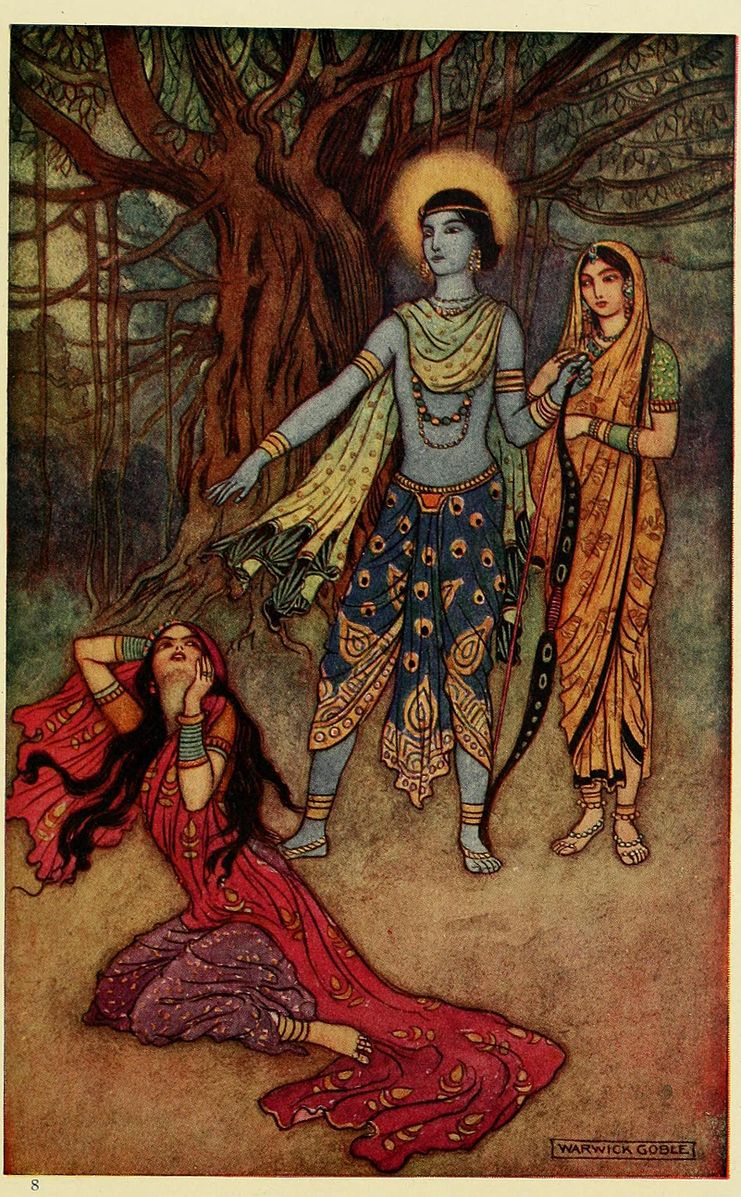
(Sita standing next to Rama as he condemn's the woman (Shurpanakha) mage from India Myth and Legend by Donald Mackenzie. Illustration by Warwick Goble. Found on Wikipedia)

            The woman turned to Rama and began sputtering nonsense.  Sita stood there amused at the insults hurled her way.  Apparently she was a sorceress who was tricking her own husband with a mirage of beauty.  It was truly laughable.  Rama caught on to the humor of the situation and sarcastically retorted to the woman, “Oh my! She is a sorceress?  How could I have been so blind?  You must be telling the truth because you yourself would know what it means to be truthful and show our true selves.  You, of course, are naturally this beautiful; no use of magic or power is used to portray your beauty.  But my wife, she must be a demon in disguise.  Am I right?”  Rama smirked at the visitor.  He finally put together who the stranger was and knew how to spite her.
            The woman became so angry that her beauty started to melt away.  Her silk hair fell out, leaving behind only ashy scalp.  The glow in her eyes burned red with fire.  Her cheeks lost their blush and became sunken and hollow.  The demon Soorpanaka finally revealed her true self.  She screamed in anger at Sita.  “Go away! Leave me with my beloved! Get out you fool!” 
( Shurpanakha transitioning into her demon form.  Found on Pixabay)

            Sita’s confidence was replaced with fear and she cowered in her husband’s arms, turning her face away from the heat of the demon into the protective chest of Rama.  This angered Soorpanaka even further and pure fire radiated from her body.   With dignity and quiet confidence, Rama held Sita close and turned his back to Soorpanaka.  He calmly walked back to the cottage getting his wife to safety.  At the door her turned and softly, yet powerfully, spoke to Soorpanaka.  “Leave us or my brother will destroy you.  We are done with you.  Save yourself before it is too late and be gone.”  He then shut the door and turned back to Sita, embracing her with his protection and enduring love. 

            Sita apologized for her initial doubt of her husband and cried in his arms as the adrenaline drained from her body.  The realization of what had just occurred crushed her body and she rested her whole soul in Rama’s arms.  He held her close and kissed the top of her head.  He wiped the tears from her eyes with his thumb and led her to the bedroom.  “You are more beautiful than the strongest mirage.  I will protect you forever, my love.”  And with a smile on her face and sweetness in her heart, Sita fell asleep in Rama’s arms. 

Author's Note:
I read the story of Rama's encounter with the demon Soorpanaka in chapter 4 of Narayan's Ramayana and instantly knew I wanted to retell the story.  This story is mostly told from Rama and Soorpanaka's perspective with Sita being a minor character.  Her thoughts are not expressed, she is merely there to cause Soorpanaka's jealousy.  I decided to tell the story through Sita's eyes.  How was she feeling while Rama was "flirting with demons"?  Was she jealous or was she always confident in he relationship with Rama?  These questions are what I expanded upon to retell the encounter.

Bibliography:
Narayan's Ramayana, link to Reading Guide A.

Reading Notes: Narayan's Ramayana, Part B

Bibliography:
Narayan's Ramayana, link to Reading Guide A.

p.67 
I love the story of Shurpanakha and Rama.  The storyline has so many different ways it can go but I love that Rama stays loyal and messes with Shurpanakha even when he doesn't know she is a demon. I also love part when Shurpanakha is so in love with Rama and hopeless that everything, even the moon annoys her.  The story is very relatable and I feel that I can make some creative changes.  It would also be interesting to write this story from Sita's perspective.  Rama remained loyal from the start even though he saw Shurpanakha to be very beautiful.  From Sita's point of view, she did not know what Rama was thinking so it would be fun to play around with her jealousy and to focus on the conversation she has with Rama after they shit Shurpanakha out of their home.  There are many possibilities with this story.
(Rama rejects Shurpanakha with Sita by his side.  Image from India Myth and Legend by Donald Mackenzie.  Illustration by Warwick Goble.  Found on Wikipedia.)

Tuesday, August 30, 2016

Reading Notes: Narayan's Ramayana Part A


Bibliography:
R. K. Narayan's Ramayana, link to Reading Guide A.

p.7 Changing Rama to a girl and having Lakshmana being the favorite son to explain the kings insistence that Lakshmana go with Rama and Vishvamitra to battle the demons.

(Vishvamitra asking king to let him take Rama to fight the demons.  Image source: Wikipedia)


p.20 The story of Ahalya is fascinating but I'm still thinking of a way to change it, make it more creative... more on this later.

p35  It would be interesting to do the back story behind why Dasharatha owes Kaikeyi two promises, resulting in Rama not becoming king.


Monday, August 29, 2016

Growth Mindset

(Math counters or "Manipulative" used for teaching simple math problems, found on Wikipedia)

I remember it like it was yesterday.  I was 6 years old, sitting in Ms. K's class reading "Frog and Toad Together" when all of a sudden, I watched the boy I chased around the playground at recess go to Ms. K's special table.  I was a very curious 6 year old girl, and I had a major crush on this little boy, so I decided to put my book down and casually walk by Ms. K's table to see what they were doing. 

On the table were our math counters, 10 or so little colored cubes we used to do math problems with, like 5+7 or 10-1.  This seemed normal but then I noticed a little shape that was different.  It was one horizontal line with a dot above and a dot below.  I stopped and stood behind Ms. K, facing the boy.  It was common knowledge that this boy was the smartest in the class.  He always read at circle and he was always the first one to finish his addition problems, so I knew whatever that symbol was, it meant it was hard.

I looked down at the table.  There was a pile of 10 cubes.  Ms. K looked at the boy and said, "Okay Cody, what is 10 divided by 2?"  He looked blank faced back at Ms. K.  She separated the pile into two smaller piles and said, "Okay how many counters are in each circle if we divide this pile of 10 into 2 piles?"

I chirped up, "5!"

Cody looked over at me surprised and Ms. K turned to me and patted me on the back, "good job McKenzie, you're right!" she said.  Then she turned back to Cody and set up a new problem.  Again, I blurted the answer out before Cody could open his mouth.  Finally, by the third problem, Ms. K turned to me and whispered, "McKenzie, I am working with Cody right now, let's let him try to answer the questions first."  So for the next 10 minutes, I whispered all the answers into Ms. K's ear while Cody tried to figure out the answers himself. 

I will always remember that day because it was the day I proved to my teacher that I was ready for more difficult work and ready to be challenged.  After that day, she started taking both me and Cody to her table to work on division and multiplication problems.  I didn't get the answers right every time but I was so proud to be sitting at Ms. K's table and being one of the only students learning how to divide 10 by 2.  

Watching Carol Dwek's videos instantly took me back to this memory, especially when she said "Make challenge the new comfort zone".  I thrived in kindergarten with those challenges.  Even today I take more difficult classes to challenge me.  I feel that I learn more when I am in a class that may be more difficult than my current level of study.  The process of challenge is where I do best and learn most.
  

Sunday, August 28, 2016

Starting the Semester with a Bullet Journal

I am compulsive about organizing! I tend to have 2-3 different planners filled with different reminders on top of the calendar app on my phone.  I used to go overboard.  Now I use what is called a "Bullet Journal".  This organizational tool helps me keep every reminder and plan in one place.  It is something I can change and shape to fit my own personal schedule and organizing needs.  You can personalize it so it best fits your way of keeping up with all of your "to-do's".

Personally, I like having one page with all of my tasks and reminders on it.  I split it up so I have all of my daily habits on one side, like working out, eating healthy, drinking water, taking medicine, etc. on one side and all of my appointments, homework, and reminders for the week on the other side.  I recreate this layout every weekend, keeping the habits the same but adjusting the reminders to fit the specific week.  The beautiful thing about the Bullet Journal is that if you want to do something completely different you can.  I always get stuck buying planners that don't fit my needs.  The boxes for individual days are too small they have no place to add reminders not relating to school, so that is why I usually have 2-3 planners to fit each need.  Now I only have one bullet journal and it's the layout I want.

Here are some examples of other people's Bullet Journals:


(John Uhri's personal Bullet Journal taken on April 29, 2016, found on flickr.)

(Pullet Journal example by Taz and Belly taken on June 2, 2015, found on flickr.)